

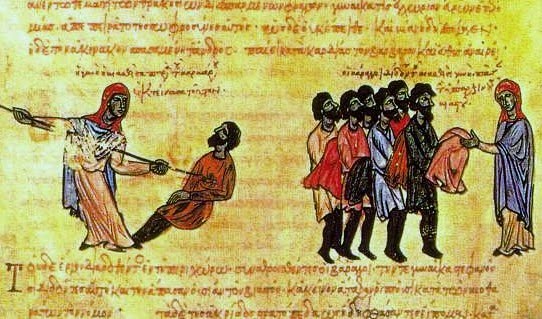
 This illustration of Viking Varangian troops near Moscow is from the chronicle of Skylitzis, he was a Greek historian, dead c. 1100
A Description of the Black Vikings of Europe By Renowned European Writers – Compiled By- Invasion2012
“blá-maðr, m. A BLACK MAN, NEGRO, i.e. AN ETHIOPIAN, Al. 51, Orkn. 364 (referring to A.D. 1152), distinguished from the Saracens and Arabians; three ‘blámenn’ were sent as a present to the German emperor Frederic the Second, Fms. x. 3: in romances blámenn are mentioned as A KIND OF ‘BERSERKERS,’” q.v., Finnb. ch. 16, Kjalnes. S. ch. 15; cp. Scott’s Ivanhoe, note B. See AN ICELANDIC-ENGLISH DICTIONARY by Richard Cleasby and Gudbrand Vigfusson(1874)
“The Irish annalists were a lesson to all with their division of Norse invaders into White Foreigners, Norwegians(Finn-gaill), and Black Foreigners, Danes(Dubh-gaill), but it was a lesson no one heeded; nor do we know why they distinguished them by colour.” See A HISTORY OF THE VIKINGS by Gwyn Jones(1968)
“The Welsh chroniclers, for example, made no such clear distinction. The Danes coming in by way of England and the Norwegians by way of Ireland were pretty well all black: Black Gentiles(y Kenedloed Duon), Black Norsemen(y Normanyeit Duon), Black Host, Pagans, Devils and the like.”(CONT.) See A HISTORY OF THE VIKINGS by Gwyn Jones(1968)
“Prince of Maine Mor(moor) was accompanied by his father Eochaidh, and his two sons Breasal and Amlaff.” Eochaid mac Run, known in English simply as Eochaid, was king of the Picts from 878 to 889 He was a son of Run, King of Strathclyde, and his mother was the daughter of Kenneth MacAlpin (NIGER VAL DUBH)
“There are turning hither to our shore lithe keels, ring-stags [ships] with long sail-yards, many shields, shaven oars, A NOBLE SEA-LEVY, MERRY WARRIORS. Fifteen companies are coming ashore, but out in Sogn there lie seven thousand more. There lie here in the dock off Cliff-holt surf-deer [ships] SWART-BLACK and GOLD ADORNED. There is by far the most of their host.” Helge Lay, i. 197-206.” See SCANDINAVIAN BRITAIN by William Gershom Collingwood(1908)
“There was a man hight Thorvard; he married Freydis, a natural daughter of Erik the Red; he went [219] also with them, and Thorvald the son of Erik (100), and THORHALL who was called the hunter; he had long been with Erik, and served him as huntsman in summer and steward in winter; he was a large man, and strong, BLACK AND LIKE A GIANT, silent and foul-mouthed in his speech, and always egged on Erik to the worst” See SAGA OF THORFINN KARLSEFNI.
“According to Egils Saga, of the 2 famous sons of Kveldulf, Thorolf was tall and handsome like his mothers people, but Grim took after his father was black and ugly. Grim’s sons Thorolf and Egill, born out in Iceland, repeated the pattern- Thorolf was the image of his uncle, tall, handsome and sunny-natured, and many Egill was black, even uglier than his father, totuous and incalculable,…..etc. craggy head, broad nose, heavy jaw and swart visage.” See A HISTORY OF THE VIKINGS, GWYN JONES pg 86
“The evidence indicates that Blacks in ancient times came to Britian from Spain, Felix Arabia, Egypt, Ethiopia, West Africa, India, Persia and what is today named Denmark. These Negroes were builders, scientists, masters of ocean travel and inventors of letters, according to Higgins, they built Stonehende, Gerald Massey agrees pg 11 Book of The Beginnings.” See Ancient and Modern Britons- MacRitchie pg 2
“The Danes, then were like the ‘MOORs’ -black. Like them, too, they were Picts, as more than one eminent writer has proved. The title of’GROM’ (WOAD-STAINED) is not confined to Highland genealogies, it was the actual name of a grim old pagan Dane who ruled over Denmark,(it meant daub).” See page 121, -David MacRitchie- Ancient and Modern Britons: Volume One (Ancient & Modern Britons)
DUBH, BLACK,SWARTHY,SWARTI
Hi there!
I’m a black haired frisian descendant and i’d like to add a few things. We Frisians use the word “swart” all the time in different situation. It is VERY common hear the sentence “Sjoch net sa SWART!” Wich litteraly translates to “Don’t look so black!”. It refers to a person looking angry, or anoyed.
“Swartkop” translates to “black face”. A black face is someone who is always mad.
I’d also like to point out that the big bad guy in germanic/norse mythology is litteraly called BLACK (surt).
I’ve grown up wich the word SWART meaning more then just a color.
I met an old frisian farmer who spoke an old type of frisian even i had difficulty following, and he refered to me as the “That black one” (Die Swarte) because of my black hair.
Yes, you’re right it was used for many things and Europeans used it toward the Africans quite often from within the areas of land mass from the middle east aka East Africa along the continent towards Morroco and on both sides of the continent of Africa to the meeting point that would near Scilly. It’s really sad how Europeans made up so many negative names towards colored people. I’m sure they had their negative names as well, it just didn’t get the publicity through the media as Europeans did and still do today.
I find this post very very interesting considering my sir name is a literal variant of Black moore. I’ve been trying to fill in the dots for years. I’m starting to wonder if I’m descended from Phoenicians now
It makes sense that there are quite a few darker people in Norway. There was a Celtic component in various parts of Northern Europe and these people tended toward darker hair and eyes (like Highland Scottish Gaels or the earlier Picts). I have seen photos of these dark brunette and brown-eyed Norwegians in the past and wondered how numerous they were.
It’s strange, because in earlier Australia if you did not have blue eyes and fair hair it was considered somehow alien. This might be because blondeness was bred into Middle Class Australians. Working Class Aussies (of which I’m one) tended to be more Celtic and therefore darker of hair and eye than their wealthier cousins.
Blá-maðr does not mean Black Man. Maor means light skinned black. You can simply say Maor or Blamaor.
Let me clarify my previous statement.
Blá-maðr does not mean African Man. Maor means light skinned black. You can simply say Maor for light skinned or Blamaor for Brown skinned.
It means to be like a African but not a African. It’s a brown skin of mix African descent.
(Bla): Blue as in African
Maor: Light skinned Black
It’s like describing a Creole person. Like Afro-Americans are like Africans but they aren’t because they are mixed therefore called Blamaor/Maor (Creoles of African descent).
Another word would be: Schwartz, Svartr, Blokumann, Celts…
Saw this on a White Supremacist RACIST Nazi website.
They have a picture of a black gentleman saying “WE WUZ VIKANGZ”
So that proves it. Even White RACIST Supremacists admit the truth.
https://creativityalliance.com/forum/index.php/topic,11547.0.html
Correction afro-american is an brand name and not a human and or have come from origins of people. AMERICAN is the correct lawful name which coincides with the aboriginals indigenous coppered swarthy ppl of the world. Lets not be naive considering some dont know who they are or the consangunity they might lead to. And spiritually once one gets close to the connection of mankind and humanity they wont coexist with the truth just become another lying lamb